

Some complexes are not made to move in certain planes; they are considered passive.
The frontal knee, for example, does not move side to side and does not have its own abductor and adductor muscles. Just like the transverse elbow cannot rotate and has no muscles that rotate it.
However true, a passive complex still “moves” a bit when caught between a complex in motion and a fixed or relatively fixed point (see image).
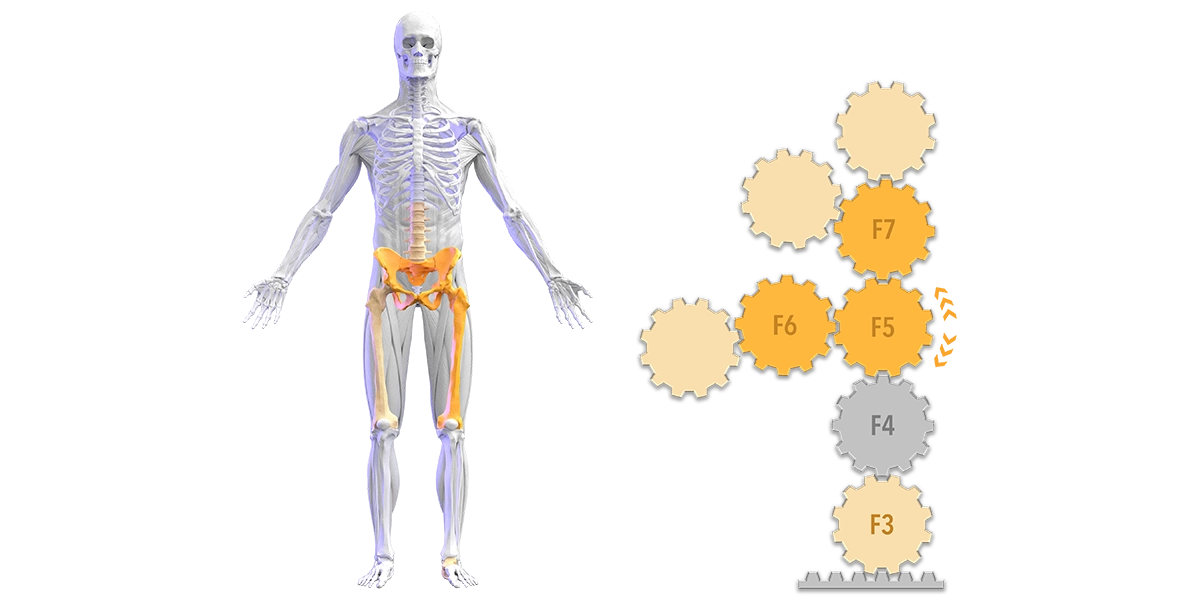
With your foot firmly on the ground, your frontal knee abducts a bit during hip adduction .
With your foot or heel on the ground (a fixed point), hip abduction and adduction (a complex in motion) make your passive frontal knee adduct and abduct—a little bit. Kicking a soccer ball (a relative fixed point) with the inside of your foot has a similar effect. For you to move the ball with your foot, you have to overcome its inertia. The ball, like the ground, resists your efforts and slows down your foot and lower leg, causing your hip adductor muscles to abduct your knee. The difference between the ground and the ball is that the ball gives in and the ground does not, hence, fixed and relatively fixed.
As long as it and its interlocking complexes are “healthy” and move well, a passive complex is made to allow and withstand a little bit of “motion.”
Plane-specific, motion-resisting ligaments and deep fasciae strengthen it. Additionally, multi-complex muscles from interlocking complexes and single-complex muscles crossing complex-shared joints provide further support.

Strong, stable, flexible, mobile, pliable, and aligned equals pain-free.
The frontal knee, for example, is directly and indirectly supported by the ACL, PCL, medial and lateral collateral ligaments, the fascia lata and fascia cruris, the medial and lateral intermuscular septa of the thigh, and the retinaculae of the knee. Multi-complex hip abductors and adductors, and the single-complex popliteus, short head of the biceps femoris, and vastus muscles lend a helping hand.
However, if it (a passive complex) and its interlocking complexes are not “healthy” and do not move well, injury and pain occur. A lack of support, for example, can lead to too much motion. In the frontal knee, too much motion results in, among others, a torn ACL.
Atlas-wise, a passive complex does not have its own chapter. If present, it's written out in grey, in the margin of a chapter’s second page.