

Motion1 is holistic. It requires the involvement of all our body’s organ systems. Because it does, I reorganized traditional human anatomy by motion in Anatomy by Planes, taking it from dissected to holistic.
In this article series, I am looking at popular treatment and exercise methods through a pair of motion-colored Anatomy by Planes glasses. The articles show which of our organ systems are affected by each method and how. They show that some treatment and exercise methods involve more organ systems than others; that some are more holistic than others.
1Motion is an umbrella term, encompassing any change in the position of the body or its parts. It ranges from cellular contraction to whole-body activity sustained by integrated organ-system function. It includes, but is not limited to, daily activities, resistance training, cardiovascular exercise, and sports.
This blog post is about yoga and Anatomy by Planes.
There are 52 styles of yoga according to Cramer et al. (2016), with notable overlap and variation. Only a dozen or so styles have been deeply researched.
As you will see, most styles include some measure of motor control, some are physically demanding, others are more calming and relaxing, some require strength and a full range of motion (ROM), and several styles are tailored to participants with physical restrictions. All in all, the spread is wide.
Yoga is usually described by its outcomes — relaxation, flexibility, and focus. This article looks at a different question: how holistic is yoga? I try to answer this question by showing you which organ systems yoga engages and whether this engagement depends on the style being practiced.
Although yoga is, as a treatment and exercise method, extensively researched, scientific evidence for which organ systems it affects and how is limited. That’s because not all of the 52-plus styles of yoga have been researched in detail, and proving their effects beyond a doubt is extremely difficult. There are simply too many variables to control.
That being said, keep in mind that yoga is a form of motion, and that motion (movement, physical activity) is holistic (see image below and the Clinical and Training Guide). So, yoga, as a form of motion, has a lot going for it.
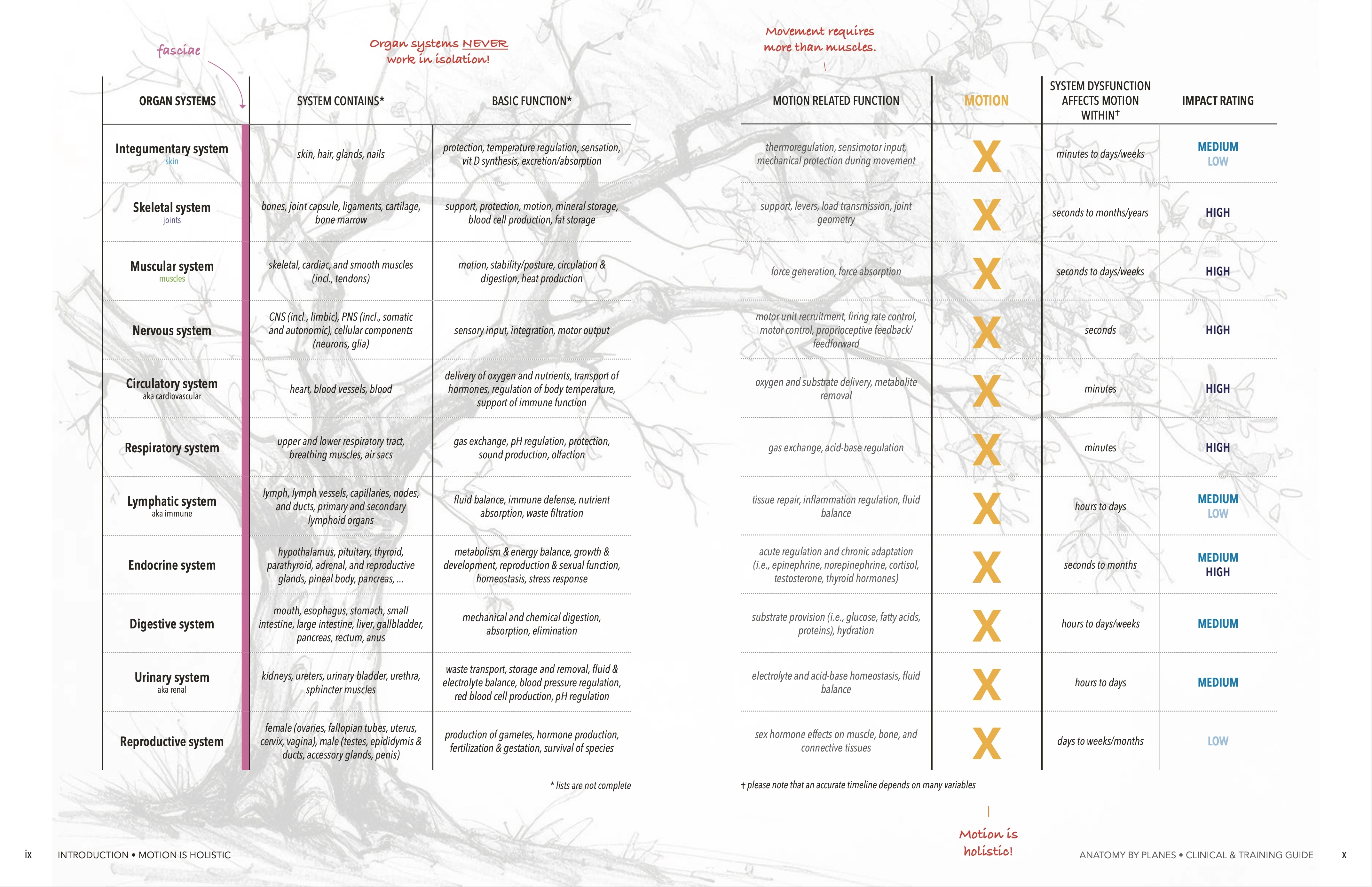
Yoga and the organ systems
The verdict: yoga, as a form of motion, is holistic by definition. Although evidence is limited across several systems, research indicates that every organ system is involved in some way. This, of course, should not come as a surprise. Yoga is, after all, a form of motion, and motion is holistic.
Whether yoga is useful for your clients is a different question altogether. It depends on many variables, such as the pain or dysfunction you are helping your client with, their general health, physical fitness, and preferences.
Like with every other treatment or exercise method, I use yoga for what it affects, see toggles above, what it is indicated for, and most importantly, how it makes my clients feel. Over the past 30 years, I have used yoga to improve motor control and ROM (muscular and skeletal), and improve recovery (nervous, endocrine, cardiovascular, lymphatic, respiratory, and digestive). For some of my clients, it worked wonders; for others, it worked adequately; and others were better helped by something other than yoga.
Please note that, like any treatment or exercise method, yoga has documented injury risks (musculoskeletal, particularly) and population-specific cautions (heat-related for hot yoga, blood pressure for inversions, etc.). Before implementing any yoga sequence into your client’s program, please ensure it’s appropriate, physically safe, and adequately balanced with everything else your client does and does not do.
References
Akhtar, P., et al. (2023). Effect of yoga and walking on glycemic control for the management of type 2 diabetes: A systematic review and meta-analysis. Journal of the ASEAN Federation of Endocrine Societies, 38(2), 113-122. PMC10692414.
Anshu, Singh, N., Deka, S., Saraswati, P., Sindhwani, G., Goel, A., Kumari, R. (2023). The effect of yoga on pulmonary function in patients with asthma: A meta-analysis. Complementary Therapies in Clinical Practice, 50, 101682. PMID: 36403343.
Bourbeau, K. C., Moriarty, T. A., Bellovary, B. N., Bellissimo, G. F., Ducharme, J. B., Haeny, T. J., Zuhl, M. N. (2021). Cardiovascular, cellular, and neural adaptations to hot yoga versus normal-temperature yoga. International Journal of Yoga, 14(2), 115-126. PMC8191229.
Corey, S. M., Epel, E., Schembri, M., Pawlowsky, S. B., Cole, R. J., Araneta, M. R. G., Barrett-Connor, E., Kanaya, A. M. (2014). Effect of restorative yoga vs. stretching on diurnal cortisol dynamics and psychosocial outcomes in individuals with the metabolic syndrome: The PRYSMS randomized controlled trial. Psychoneuroendocrinology, 49, 260–271. PMID: 25127084.
Cramer, H., Langhorst, J., Dobos, G., Lauche, R. (2016). Yoga for metabolic syndrome: A systematic review and meta-analysis. European Journal of Preventive Cardiology, 23(18), 1982–1993. PMID: 27550905.
Cramer, H., Lauche, R., Langhorst, J., Dobos, G. (2016). Is one yoga style better than another? A systematic review of associations of yoga style and conclusions in randomized yoga trials. Journal of Psychiatric Research, 25, 178-187. PMID: 27062966.
Cramer, H., Peng, W., Lauche, R. (2018). Yoga for menopausal symptoms — A systematic review and meta-analysis. Maturitas, 109, 13–25. PMID: 29452777.
D'Silva, A., MacQueen, G., Nasser, Y., Taylor, L. M., Vallance, J. K., Raman, M. (2020). Yoga as a therapy for irritable bowel syndrome. Digestive Diseases and Sciences, 65(9), 2503–2514.
Falkenberg, R. I., Eising, C., Peters, M. L. (2018). Yoga and immune system functioning: A systematic review of randomized controlled trials. Journal of Behavioral Medicine, 41(4), 467–482. PMID: 29429046.
Giridharan, S., Simian, S., Kumar, N. V., Ansari J. (2025). Effects of yoga on gene expression: A systematic review of randomised controlled trials. Cureus 17(4): e82690. PMC12094062.
Gothe, N. P., Khan, I., Hayes, J., Erlenbach, E., Damoiseaux, J. S. (2019). Yoga effects on brain health: A systematic review of the current literature. Brain Plasticity, 5(1), 105–122. PMC6971819.
Huang, A. J., Jenny, H. E., Chesney, M. A., Schembri, M., Subak, L. L. (2014). A group-based yoga therapy intervention for urinary incontinence in women: A pilot randomized trial. Female Pelvic Medicine & Reconstructive Surgery, 20(3), 147–154.
Hurtado, M. M., Meza Valladares, C., Eblen-Zajjur, A., Rodriguez-Fernandez, M. (2019). Acute cardiovascular responses to a session of Bikram yoga: A pilot uncontrolled trial. Journal of Alternative and Complementary Medicine, 25(3), 338–346. PMID: 30698456.
Kanaya, A. M., Araneta, M. R. G., Pawlowsky, S. B., Barrett-Connor, E., Grady, D., Vittinghoff, E., Schembri, M., Chang, A., Carrion-Petersen, M. L., Coggins, T., Tanori, D., Armas, J. M., Cole, R. J. (2014). Restorative yoga and metabolic risk factors: The Practicing Restorative Yoga vs. Stretching for the Metabolic Syndrome (PRYSMS) randomized trial. Journal of Diabetes and its Complications, 28(3), 406–412. PMC4004660.
Khattab, K., Khattab, A. A., Ortak, J., Richardt, G., Bonnemeier, H. (2007). Iyengar yoga increases cardiac parasympathetic nervous modulation among healthy yoga practitioners. Evidence-Based Complementary and Alternative Medicine, 4(4), 511–517.
Ko, K. Y., Kwok, Z. C. M., Chan, H. Y. L. (2023). Effects of yoga on physical and psychological health among community-dwelling older adults: A systematic review and meta-analysis. International Journal of Older People Nursing, 18(5): e12562. PMID: 37577926.
Li, K., Huang, J., Zhu, F. (2025). The optimal exercise modality and dose for cortisol reduction in psychological distress: A systematic review and network meta-analysis. Sports 13(12), 415. PMC12736704.
Liu, X. C., Pan, L., Hu, Q., Dong, W. P., Yan, J. H., Dong, L. (2014). Effects of yoga training in patients with chronic obstructive pulmonary disease: A systematic review and meta-analysis. Journal of Thoracic Disease, 6(6), 795–802. PMID: 24977005.
Mishra, B., Agarwal, A., George, J. A., Upadhyay, A. D., Nilima, N., Mishra, R., Kuthiala, N., Basheer, A., Vishnu, V. Y., Srivastava, V. P. (2024). Effectiveness of yoga in modulating markers of immunity and inflammation: A systematic review and meta-analysis. Cureus, 16(4): e57541. PMC11068076.
Pavan, F., Yadav, S. S., Constantino, A., Dell’Era, A., Mastroianni, M., Buoli, M. (2025). The effectiveness of yoga for irritable bowel syndrome: A systematic review. Comprehensive Physiology 15(5): e70061. PMC12535283.
Rathore, V. K., Singh, S., Yadav, N. (2025). Impact of yoga on pulmonary functions in clinical population: A systematic review and meta-analysis of randomized controlled trials. Journal of Ayurveda and Integrative Medicine, 16(5): 101189. PMC12451276.
Sivaramakrishnan, D., Fitzsimons, C., Kelly, P., Ludwig, K., Mutrie, N., Saunders, D. H., Baker, G. (2019). The effects of yoga compared to active and inactive controls on physical function and health related quality of life in older adults — Systematic review and meta-analysis of randomised controlled trials. International Journal of Behavioral Nutrition and Physical Activity, 16(1), 33. PMC6451238.
Thakur, D., Saurabh Singh, D. R., Tripathi, M., & Lufang, D. (2021). Effect of yoga on polycystic ovarian syndrome: A systematic review. Journal of Bodywork and Movement Therapies, 27, 281–286. PMID: 34391246.
Thakur, E. R., Shapiro, J. M., Wellington, J., Sohl, S. J., Danhauer, S. C., Moshiree, B., Ford, A.C., Koch, K. (2026). A systematic review of yoga for the treatment of gastrointestinal disorders. Neurogastroenterology & Motility, 38(1):e14915. PMID: 39285826.
Tyagi, A., Cohen, M. (2016). Yoga and heart rate variability: A comprehensive review of the literature. International Journal of Yoga, 9(2), 97–113. PMC4959333.
van Aalst, J., Ceccarini, J., Demyttenaere, K., Sunaert, S., & Van Laere, K. (2020). What has neuroimaging taught us on the neurobiology of yoga? A review. Frontiers in Integrative Neuroscience, 14, 34. PMC7362763.
Willmott, A. G. B., James, C. A., Jewiss, M., Gibson, O. R., Brochure, F., Nee, J. A. (2025). Hot yoga: A systematic review of the physiological, functional and psychological responses and adaptations. Sports Medicine Open, 11(1), 110. PMC12488547.