

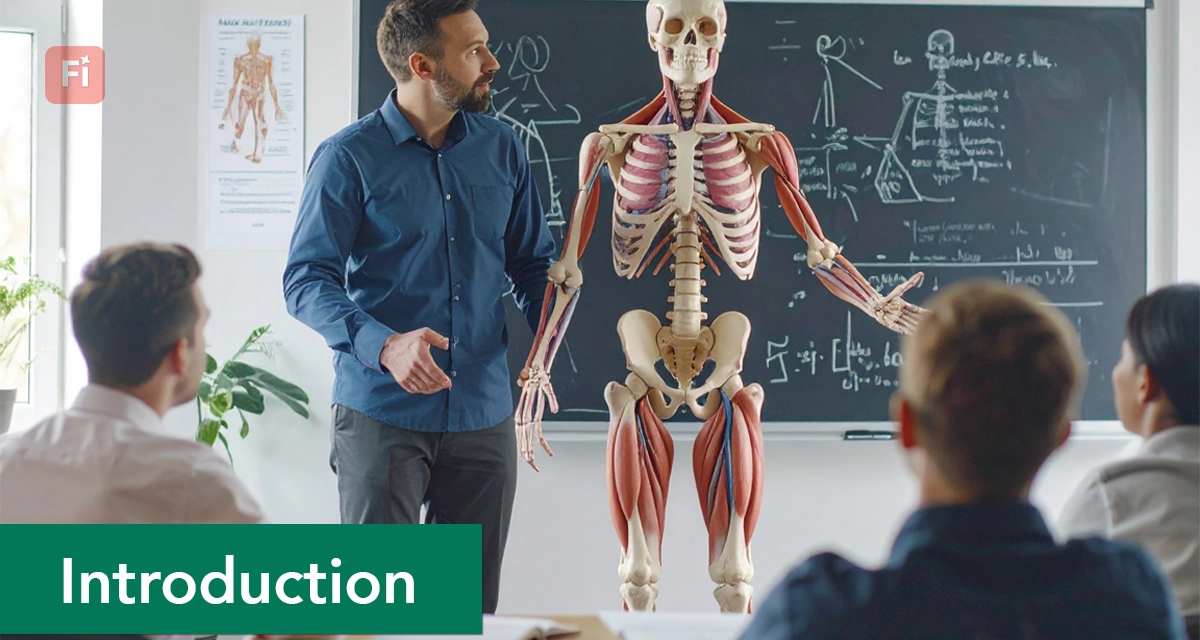
Like every other massage and soft-tissue therapist, I was taught traditional anatomy. Everything dissected, parts laid out, examined, and described. Grouped into upper extremity, lower extremity, and torso, I studied the integumentary, muscular, skeletal, nervous, circulatory, and lymphatic systems and all their individually named parts.
Good times!
I learned a great deal about the body’s structure, but soon realized that my knowledge was hard to apply in practice.
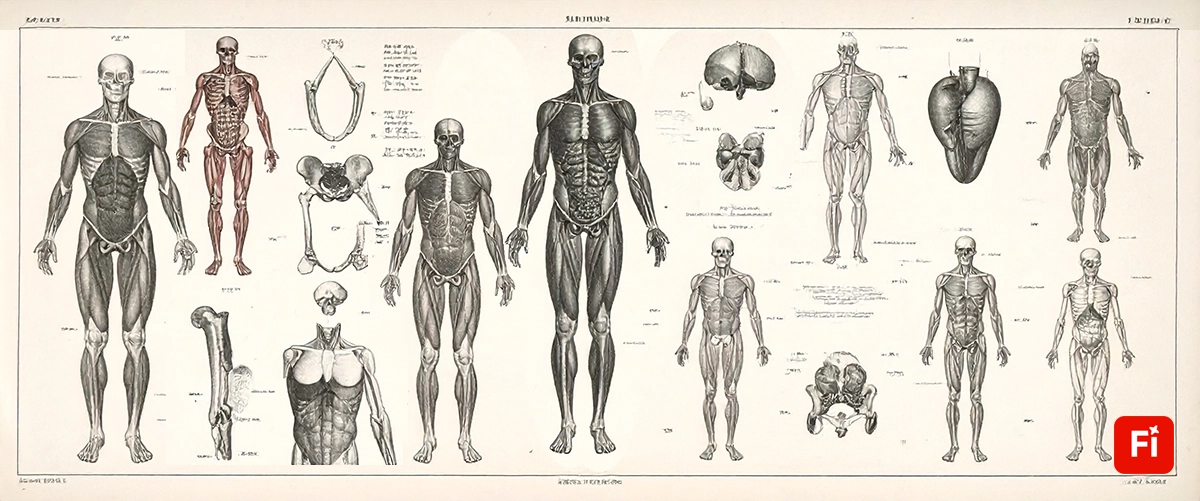
Traditional human anatomy according to AI.
As a soft-tissue therapist, I look at the body as a whole, not just individual joints or muscles. I often use the word “holistic.” I explain to my clients that everything connects and promote soft-tissue treatment that considers the whole body. I talk about the ongoing “chatter” between organ systems and their parts. How skin, muscles, and joints interconnect, move together, and change each other. And how, because of that, the knee affects the hip and, in turn, the ankle affects the knee.
In practice, I focus on the movements that cause pain and the way skin, muscles, and joints work together to resolve musculoskeletal pain complaints. To do this well, I need to understand how these parts connect to specific motions and to each other.
Without reorganizing it or looking at it from a different perspective, traditional anatomy does not give me the information I need. And honestly, why should it? It is its own science and wasn’t created with soft tissue therapy in mind. It doesn’t show how skin, muscles, and joints influence each other or how they relate to movement. Its goal is to study the body’s structure.
Take the word “anatomy.” It comes from the Greek “ana-tomia,” which loosely translates to “cutting up.” This makes sense when you consider Henry Gray, the renowned anatomist. His Gray’s Anatomy is a meticulous description of a dissection: limb by limb, piece by piece, layer by layer. By dividing the human body into smaller parts and studying its structural and topographical traits, it tries to make sense of something large and very complex, which it does.
But traditional anatomy isn’t designed for massage and soft-tissue therapists like us. It doesn’t offer a practical or holistic view, and it doesn’t help us quickly address musculoskeletal pain.
For us to use it in a clinical setting, it requires a reorganization.
So, that’s what I did.










⭐️⭐️⭐️⭐️⭐️