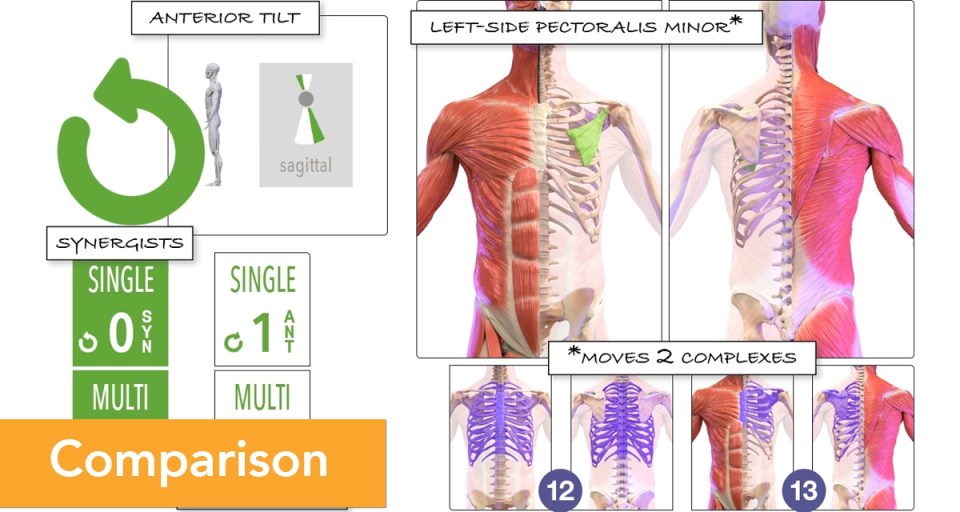


Ch. 4.3: Single- and Multi-Complex Muscles

Muscles cross one or multiple complexes. Single-complex muscles are prime movers, while multi-complex muscles assist with motion, coordination, and stability.

Written by

Willem Kramer

Published on

July 20, 2025

Almost every complex contains both single-complex muscles and multi-complex muscles.

Single-complex muscles are responsible for moving only one complex, mostly in either a clockwise or counterclockwise direction. However, they can sometimes move it in both directions. Despite moving just one complex, they often engage multiple joints (see chapter 4.2).

Single-complex muscles are considered direct or prime movers.

In contrast, multi-complex muscles are responsible for moving two or more complexes simultaneously, either in a clockwise or counterclockwise direction.

Multi-complex muscles play a crucial role in motion, coordination, and stability across multiple complexes, often affecting many joints at the same time.

It is important to realize that a muscle generates motion in one or more anatomical planes and that it moves one or more complexes. In other words, whether a muscle is classified as a single-complex or multi-complex, it can move in one, two, or all three anatomical planes.

5 1 vote
Article Rating
Subscribe
Notify of
guest

0 Comments

Author

Willem Kramer is a Netherlands-trained physiotherapist and US-licensed massage therapist with over thirty years of experience working with professional athletes, entertainers, and executives worldwide. He reorganizes anatomy around how the body moves, working from the premise that motion is a whole-body event involving all twelve organ systems within the anatomical planes of motion. He is the author of Anatomy by Planes — a three-atlas set with a foreword by Andrew Luck — and its companion Clinical & Training Guide, and the creator of Motion Anatomy (motionanatomy.com), a free introduction to the framework.

booshop-org-icon_orange-EB801D-hover-637C77

Related posts

Including atlas "Introduction," "Comparison," "Quiz," "Bibliography," and "News" posts.
July 1, 2025

Dissection vs AxP Anatomy: Tibialis Anterior (L)

Compare dissection anatomy and soft tissue therapy anatomy: The left-sided tibialis anterior inverts the “frontal ankle,” is a single-complex muscle, has one single-complex synergist, two single-complex antagonists, three multi-complex synergists, and one multi-complex antagonist.
0
Would love your thoughts, please comment.x
()
x
Privacy Overview

This website uses cookies so that we can provide you with the best user experience possible. Cookie information is stored in your browser and performs functions such as recognising you when you return to our website and helping our team to understand which sections of the website you find most interesting and useful. For more information you can read our Privacy Policy.