
Dissection vs AxP Anatomy: Peroneus Longus & Brevis (L)

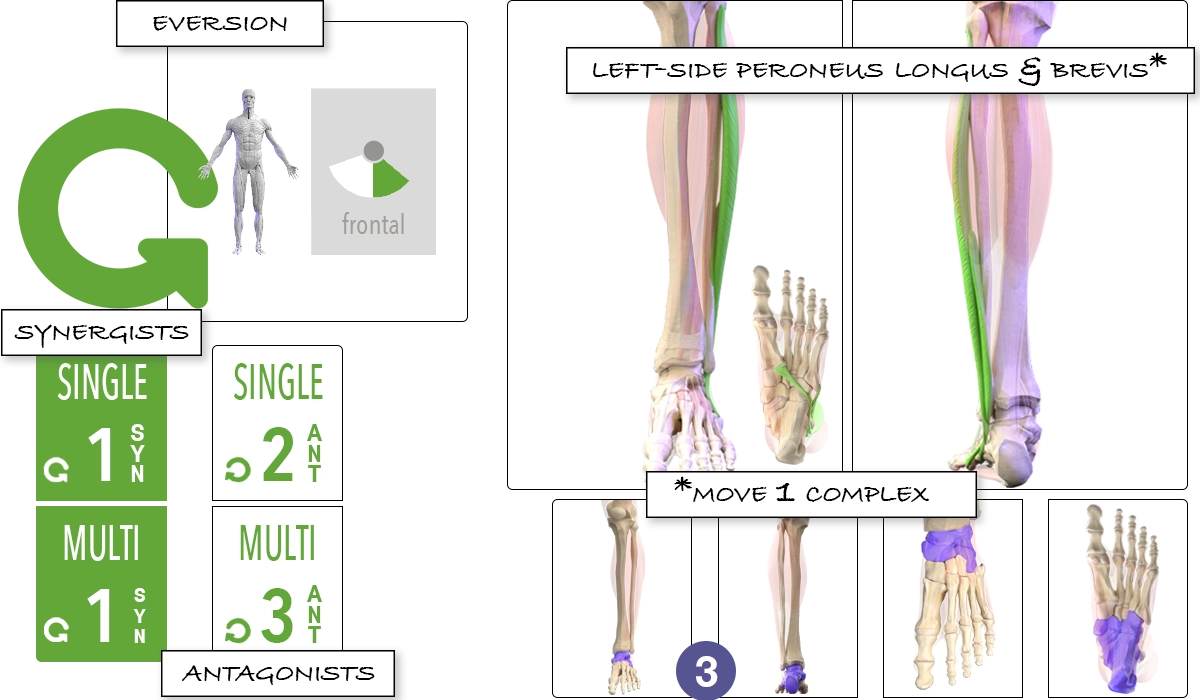
Compare dissection anatomy and soft tissue therapy anatomy: The left-sided peroneus longus & brevis evert the “frontal ankle,” are single-complex muscles, have one single-complex synergist, two single-complex antagonists, one multi-complex synergists, and three multi-complex antagonist.

Written by

Willem Kramer

Published on

June 19, 2025

Anatomy by Planes

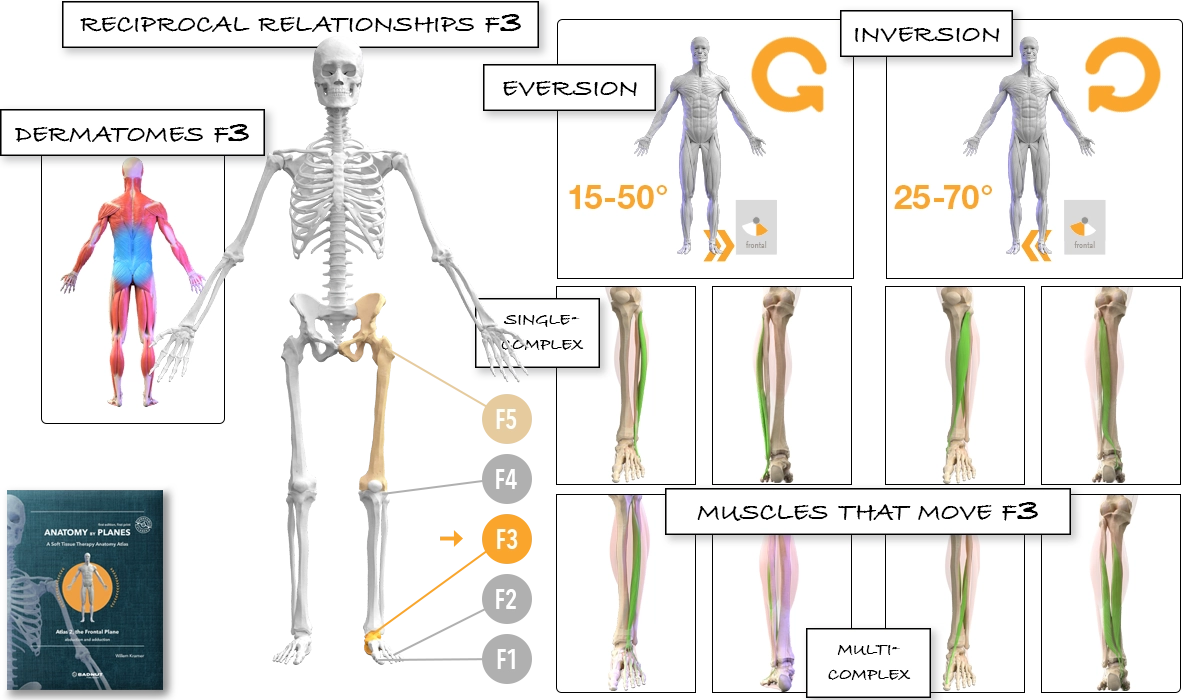
FRONTAL ANKLE COMPLEX (F3)

Plane
Frontal plane.

Complex 
Frontal ankle, F3.

Joints
Talocalcenal joint.
Transverse tarsal joints.

Motions
15 - 50 degrees eversion.
25 - 70 degrees inversion.

Dermatomes
T11 - S2.

Indirect Motion
None.

Reciprocal Relationships
Frontal hip, F5.
Frontal knee, F4. #
Frontal ankle, F3.
Frontal lesser toes, F2. #
Frontal big toe, F1. #
# passive complex

LEFT-SIDE PERONEUS LONGUS & BREVIS

Motion
Eversion (and abduction).

Muscles
Peroneus longus & brevis.

Single-Complex
Ankle.

Depth of Muscle
Level 1, just under the skin. The peroneus brevis is, with exception of its longitudinal posterior half, located deep to the longus.

Single-Complex Synergists (1)
Peroneus tertius.

Single-Complex Antagonists (2)
Tibialis anterior.
Tibialis posterior.

Multi-Complex Synergists (1)
Extensor digitorum longus.

Multi-Complex Antagonists (3)
Extensor hallucis longus.
Flexor digitorum longus.
Flexor hallucis longus.

Traditional Anatomy

Proximal attachments
The peroneus longus connects with the lateral upper half of the fibula, the anterior and posterior internuscular septa of the leg, and the fascia cruris. The peroneus brevis connects with the lateral, lower two-thirds of the fibula, as well as the anterior and posterior intermuscular septa.

Distal attachment
The peroneus longus connects with the plantar posterolateral surface of the medial cuneiform and the lateral surface of the base of the first metatarsal. The peroneus brevis connects with the lateral surface of the base of the fifth metatarsal.

Location
The muscles are located on the outside of the leg. Their tendons pass behind the lateral malleolus, the longus tendon covering that of the brevis. On the outside of the foot, the tendons are secured by two peroneal retinaculae. From here, the longus tendon passes into the foot deep to the plantar fascia, foot muscles, and long plantar ligament. The brevis tendon continues over the lateral foot for a short while.

Innervation
Superficial peroneal nerve. The peroneus longus sometimes receives branches from the common peroneal or deep peroneal nerves.

Vascular Supply
Anterior tibial artery and peroneal artery.

Motion
Eversion.
Plantar flexion.

0 0 votes
Article Rating
Subscribe
Notify of
guest

0 Comments

Author

Willem Kramer is a Netherlands-trained physiotherapist and US-licensed massage therapist with over thirty years of experience working with professional athletes, entertainers, and executives worldwide. He reorganizes anatomy around how the body moves, working from the premise that motion is a whole-body event involving all twelve organ systems within the anatomical planes of motion. He is the author of Anatomy by Planes — a three-atlas set with a foreword by Andrew Luck — and its companion Clinical & Training Guide, and the creator of Motion Anatomy (motionanatomy.com), a free introduction to the framework.

booshop-org-icon_orange-EB801D-hover-637C77

Related posts

Including atlas "Introduction," "Comparison," "Quiz," "Bibliography," and "News" posts.
June 19, 2025

Dissection vs AxP Anatomy: Peroneus Longus & Brevis (L)

Compare dissection anatomy and soft tissue therapy anatomy: The left-sided peroneus longus & brevis evert the “frontal ankle,” are single-complex muscles, have one single-complex synergist, two single-complex antagonists, one multi-complex synergists, and three multi-complex antagonist.
July 30, 2025

Dissection vs AxP Anatomy: Latissimus Dorsi (R)

Compare dissection anatomy and soft tissue therapy anatomy: The right-sided latissimus right rotates the “transverse thoracic,” moves five complexes in total, has three single-complex synergists and antagonists, five multi-complex synergists, and six multi-complex antagonists.
0
Would love your thoughts, please comment.x
()
x
Privacy Overview

This website uses cookies so that we can provide you with the best user experience possible. Cookie information is stored in your browser and performs functions such as recognising you when you return to our website and helping our team to understand which sections of the website you find most interesting and useful. For more information you can read our Privacy Policy.