
For most massage, soft-tissue, and movement therapists, muscles take center stage. They are seen as the most important and often discussed. Books, websites, and social media highlight troublesome muscles, their anatomy, and how to "solve" them. When a client visits a therapist, the focus is on muscles: they are treated, trained, and stretched.
That focus is understandable but incomplete.
Muscles do not work in isolation. No part of the human body does. Muscles work with other muscles, joints, skin, nerves, blood vessels, and more.
Trying to treat and train muscles in isolation is, therefore, a flawed approach.
An "isolated muscle approach" is like a conductor working with a single violinist while ignoring the other ninety-nine members of the orchestra. A single violinist is not an orchestra, and focusing on one section member cannot produce a good performance, let alone a great one.
Compared to an orchestra, the body is infinitely more complex, with many more "musicians" to attend to and work with.
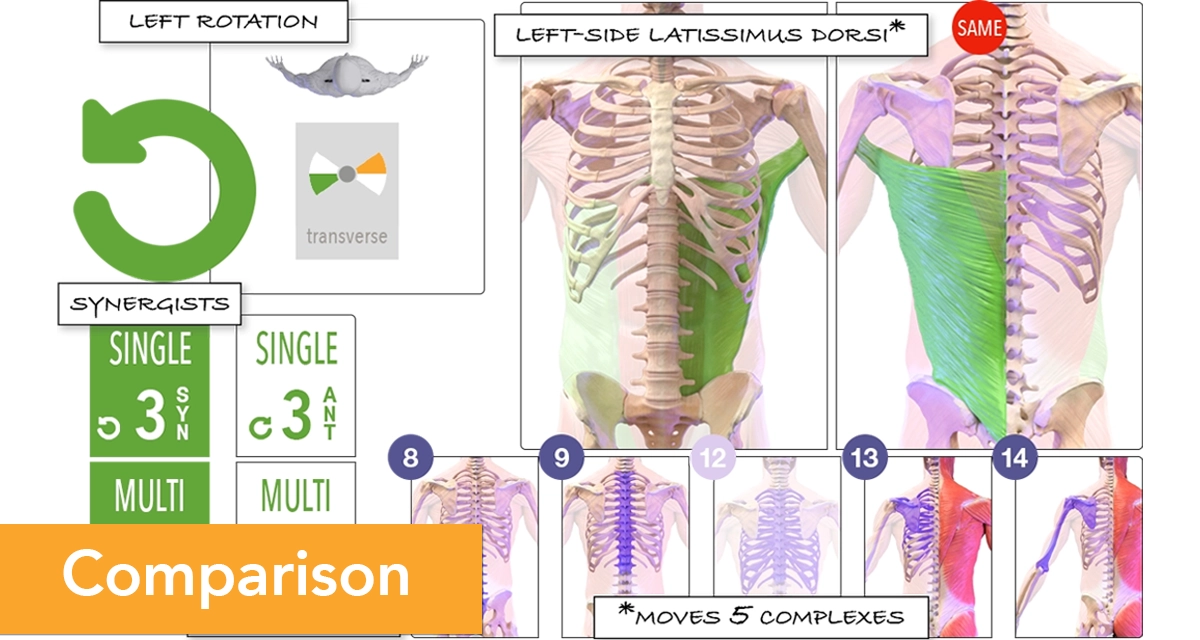
Take the iliopsoas, for example. It’s considered an infamous troublemaker, often blamed and frequently treated. This muscle consists of two muscles combined: the iliacus and the psoas major. In the sagittal plane, the iliopsoas moves the hip complex and lumbar complex. In the frontal plane, it moves the lumbar complex. In the transverse plane, it again moves the hip and lumbar complexes.
As the violinist plays with the strings, woodwinds, brass, and percussion, so does the iliopsoas work with the integumentary, skeletal, muscular, nervous, circulatory, and other organ systems.
The iliopsoas does not move the hip and lower back on its own. It does assist walking and running on its own. It does not provide vertebral and pelvic stability on its own. And, it does not help you sit up on its own either. In everything it does, the iliopsoas always relies on the other organ systems. Like the violinist plays with the strings, woodwinds, brass, and percussion, so does the iliopsoas work with the integumentary, skeletal, muscular, nervous, circulatory, and other organ systems.
Moreover, if the iliopsoas is the “cause” of back, hip, and groin pain or dysfunction, it does not cause any of these on its own. It cannot.
And finally, if you think you’re treating or training the iliopsoas on its own, think again. You cannot. It is impossible.
The iliopsoas and its reciprocal relationships. *
* The list contains most of the parts of the eleven organ systems that relate to and collaborate with the iliopsoas muscle.
Pick any muscle and do this exercise. The list will be just as long. The iliopsoas is not unusual; it is representative.
In light of all of this, one can only conclude that the iliopsoas is so much more than just the psoas major and iliacus combined.
I propose that we, as massage, soft-tissue, and movement therapists, stop viewing muscles, joints, and other parts as if they exist and function alone. They do not and cannot.
For practical purposes, we should see the body as one and treat it as such, taking into account everything it is made of and everything that influences it.
Muscles, Part 2
References
- Bialosky, J. E., Beneciuk, J. M., Bishop, M. D., Coronado, R. A., Penza, C. W., Simon, C. B., George, S. Z. (2018). Unraveling the mechanisms of manual therapy: Modeling an approach. Journal of Orthopaedic & Sports Physical Therapy, 48(1), 8–18. doi:10.2519/jospt.2018.7476
- Bordoni, B., Varacallo, M. (2023). Anatomy, bony pelvis and lower limb: Psoas major. StatPearls. NCBI Bookshelf: NBK531508
- Bordoni, B., Zanier, E. (2013). Anatomic connections of the diaphragm: Influence of respiration on the body system. Journal of Multidisciplinary Healthcare, 6, 281–291. doi:10.2147/JMDH.S45443
- Severinsen, M. C. K., Pedersen, B. K. (2020). Muscle–organ crosstalk: The emerging roles of myokines. Endocrine Reviews, 41(4), 594–609. doi:10.1210/endrev/bnaa016
- Singh, R. E., Iqbal, K., White, G., & Hutchinson, T. E. (2018). A systematic review on muscle synergies: From building blocks of motor behavior to a neurorehabilitation tool. Applied Bionics and Biomechanics, 2018, 3615368. doi:10.1155/2018/3615368
- Standring, S. (2020). Gray's Anatomy: The Anatomical Basis of Clinical Practice (42nd ed.). Elsevier. WorldCat: ISBN 9780702077050